A Face Near, a World Far Away
Close framing and wide framing guide attention differently; learn to read what each reveals, hides, and changes about a character’s surroundings.
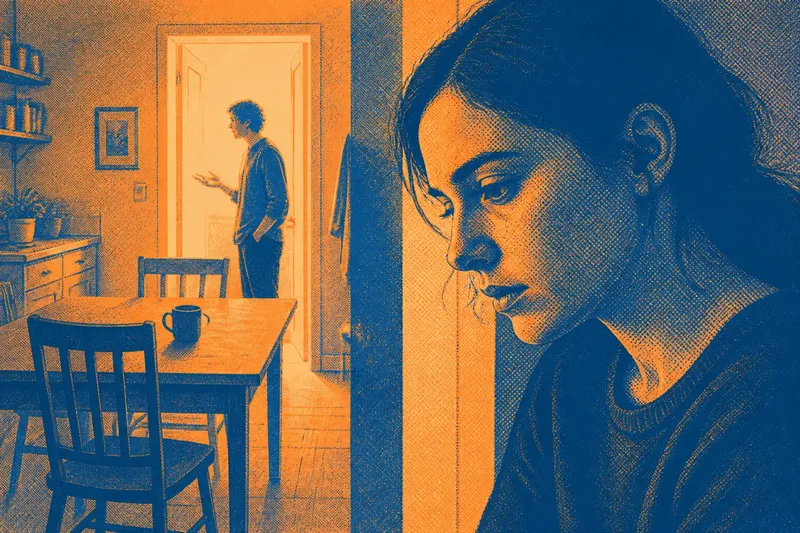
Close framing and wide framing are easiest to misread when treated as shorthand: close means emotion, wide means information. That shortcut costs the viewer the scene’s geography. A face may become vivid while its surroundings grow uncertain, or a distant figure may be easy to locate but difficult to read. Framing shapes not only how near a character seems, but also which parts of their world remain available to us.
A close view can make a small change in expression feel consequential, yet detach a character from the room. A wide view can clarify where someone stands in relation to doors, furniture, or other people, while leaving facial detail out of reach. The more useful question is what each shot lets us compare, and how that comparison alters our sense of the character’s circumstances.
Close framing makes small changes legible while reducing context
In a close framing, the face or upper body occupies much of the image. With fewer competing details, a shift of the eyes, a held expression, or a pause before speech can attract attention. The effect can feel private even when the character is in a crowded or public place.
The world rarely vanishes entirely. A strip of window, a blurred shoulder at the edge, or the color of a wall can keep the setting present. Those fragments may matter precisely because they are hard to read: a bright doorway behind a character can suggest an exit or an unseen space without showing what lies beyond it.
Look at the borders as carefully as the face. If a companion remains audible but is cropped out, the image can make the character’s isolation more pronounced. If another person’s shoulder stays in frame, the same close view may feel crowded or confrontational. The crop changes who shares the character’s space, even when the camera does not move.
Wide framing makes spatial relationships visible
A wide framing gives the surroundings more room. It can show where a character stands, what lies between people, and how a room’s layout shapes movement. A gap across a table, a long corridor, or an empty stretch of landscape makes distance visible without requiring dialogue to name it.
That clarity does not dictate an emotional reading. A character placed small in a large room may seem exposed, constrained, or simply part of a larger environment. The effect depends on what draws the eye: architecture may dominate, or the character’s position within it may become the scene’s central detail.
Wide framing is not automatically neutral. The camera still selects its position and the relationships it includes. Several figures sharing a frame can make a conversation’s alliances or exclusions visible; a person near the edge can leave empty space more prominent than the person themselves.
Framing determines which details can be compared
Scale matters, but comparison often matters more. A close view can let us compare a character’s words with their expression while keeping another person’s reaction outside the image. A wide view can place both people’s gestures and positions together, though a subtle facial change may be harder to distinguish.
A change in framing can therefore alter the viewer’s evidence. Cutting from a wide view to a close one may shift attention toward a response while removing the room’s layout. Cutting outward can restore that layout, reveal a listener, or complicate an impression of solitude. The change is not merely bigger or smaller; it changes what can be known at once.
Imagine a fictional scene in which someone waits beside a kitchen table while a family member speaks from offscreen. The opening wide view includes the table, doorway, and waiting person, establishing their positions. A cut closer makes the person’s restrained expression easier to see but hides the doorway, so attention shifts from the room’s arrangement to the response. If a later wide view reveals that the speaker has remained outside the doorway, the viewer can reconsider whether the close shot felt intimate or instead emphasized separation.
What can make framing feel confusing?
Why does a close shot make a character seem detached from the scene?
The crop may hide the people or objects that explain the character’s position. Look for an edge detail, a matching shot, or a sound that locates the unseen space; each can reconnect the face to the room.
Why does a wide shot make an emotional moment feel distant?
The face may be too small for a subtle expression to register, while the surroundings draw the eye elsewhere. Posture, stillness, or the distance between figures may carry the emotion instead.
Why can a cut between wide and close views feel abrupt?
The cut may change both image scale and available spatial information, asking the viewer to reorient while shifting attention. Check whether a position, eyeline, or movement continues across the cut and helps preserve the scene’s geography.
Why does a character seem more important in one shot than another?
One framing may place the character among several figures, while another gives them most of the image. Ask whether the scene has shifted your attention or changed the character’s actual relation to the others.
Use visible details to test an interpretation
When a shot feels emotionally clear but spatially confusing, start with its borders. Note which person or object has been cropped out and whether the image leaves room for an unseen presence. In a reverse angle—the view from the opposite side of an exchange—compare positions and eyelines rather than assuming each shot gives an equal account of the space.
When a wide shot seems empty, locate the character against a fixed feature such as a doorway, window, or table. That detail gives distance a shape. The question is not simply how small the person looks, but what the surrounding space appears to allow or prevent.
- Observe whether a close shot retains a window or doorway; if it does, use that fragment to keep the location in view, and if it does not, check the next shot or sound for spatial clues.
- Observe whether a companion is audible but absent from the frame; if so, consider how the crop makes the exchange feel, and if not, compare the visible companion’s position with the character’s.
- Observe whether the background is blurred; if it is, treat the setting as present but indistinct, and if it is sharp, compare its details with the character’s expression.
- Observe whether a wide shot places a character beside a fixed feature; if it does, use that relation to read distance, and if it does not, look for another stable point in the room.
- Observe whether an eyeline continues across a cut; if it does, use it to connect the shots, and if it does not, reconsider where the camera places each person.
- Observe whether a second person’s reaction remains visible; if it does, compare the two responses, and if it does not, note that the scene limits access to that person’s reaction.
Say a viewer watches an imagined exchange in a clinic waiting room: the initial wide shot shows a patient beside a glass door and a nurse near the desk; the cut to a close view crops out the nurse, while the door’s pale edge remains. The viewer notes that the patient’s lowered eyes are newly legible, but the remaining door fragment still connects the face to the room. When a reverse angle then shows the nurse looking toward the patient, the viewer revises the first impression of solitude: the close view narrowed attention, but it did not establish that the patient was alone.
What does close framing and wide framing establish?
A close view does not prove that a character is honest, vulnerable, or understood, and a wide view does not prove that a scene is detached or impartial. Framing works alongside performance, camera position, editing, and sound. A close image may make a withheld response legible; a wide one may preserve ambiguity while showing who else can see it.
Describe the visible choice before assigning an emotion: the camera moves nearer, the background softens, or a second person falls outside the frame. Then ask what the choice changes for the viewer. Close framing and wide framing guide attention by controlling which expressions, relationships, and spatial clues can be weighed together.
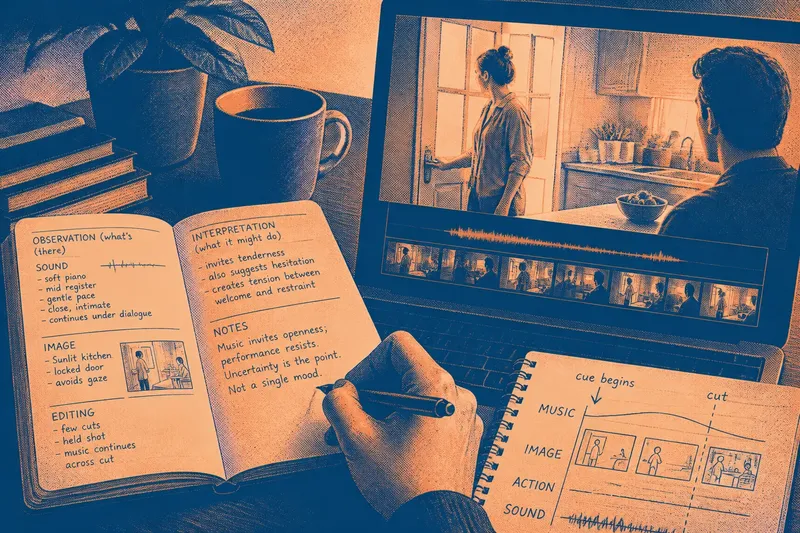
A useful viewing note can stay modest: name the character’s place in the frame, the surrounding space that remains visible, and what a cut makes available or withholds. That record keeps interpretation tied to the image. Often, the most revealing detail is not the face itself but the fragment of the world the frame allows to remain beside it.