The Background Music Is Not a Mood Button
Film music invites feeling without prescribing it. Learn to hear how cues interact with image, silence, performance and editing, and describe those choices precisely.
The common mistake in listening to film music is to treat a cue as a button: strings appear, so the scene means sadness; drums gather, so danger must be near. That shortcut costs the viewer the scene’s particular tensions. Film music can invite a feeling, sharpen an expectation, or make an image newly strange, but it cannot dictate one response to every listener.
A better account begins with what the music makes noticeable, then turns to what the scene does with that invitation. A held note beside a guarded expression, for instance, may leave the viewer balancing suspense against restraint. Listen for that relationship rather than assigning the cue a single emotional label.
Describe the cue before interpreting it
Choose a scene you can revisit easily, from a streaming service, disc, or legal digital copy. Keep a notebook nearby; editing software is unnecessary. Pick a passage with a clear stretch of music and enough visual or dramatic change to give your listening something to compare.
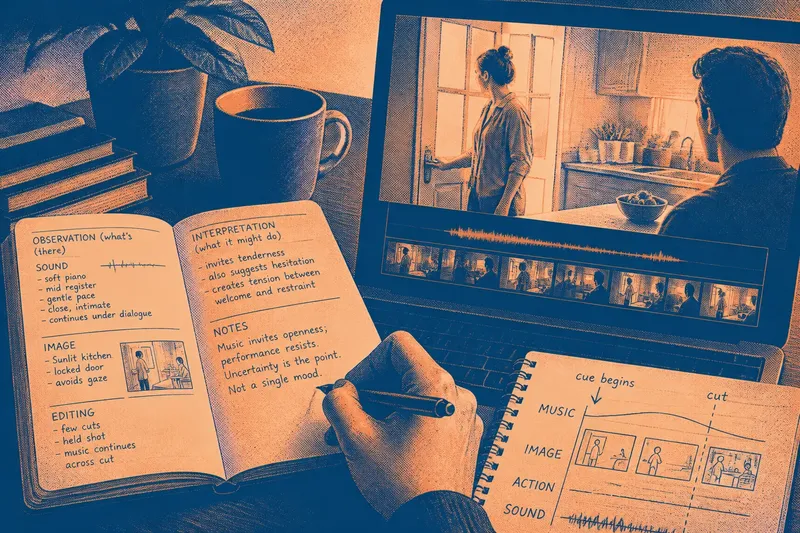
Watch once without pausing. Note who enters or leaves, what changes in the frame, where the scene cuts, and whether anyone speaks. Then describe the cue in audible terms: its texture, register, pace, volume, and apparent distance. “A low, sustained tone continues under the dialogue” is a stronger starting point than “the music is ominous.”
Keep sound and interpretation in separate notes. The first records what is there; the second proposes what it might do.
Hear film music as an invitation, not an instruction
A cue can make some qualities more available without settling the scene’s meaning. A gentle melody over a troubling image might invite tenderness, but it can also seem ironic, misplaced, or unsettling. A bright cue may lend an ordinary action a sense of ceremony, or make that ceremony feel forced. The image, performance, and story shape which readings remain persuasive.
Instead of writing “the music tells me this is sad,” ask what the cue encourages you to notice and what in the scene resists that feeling. A rigid posture, an unreturned look, a brightly lit room, or an abrupt cut can complicate the invitation without canceling it.
Say you choose a scene where a character stands in a sunlit kitchen as a soft piano phrase plays. The character keeps one hand on the door and avoids another person’s gaze. Note the gentle piano and the guarded behavior separately; the resulting description can hold both welcome and hesitation, rather than reducing the scene to one mood.
Track how acting and music meet
On another viewing, attend to the actors’ faces, posture, timing, and gestures. A warm string line may accompany a character who barely moves; a threatening drone may continue beneath an ordinary exchange. The score’s apparent direction does not have to match the performance.
Notice when the cue begins in relation to a gesture or line. If it arrives before a character answers, the response may feel anticipated. If it enters afterward, it may color the answer as an afterthought. These are possible effects, not fixed rules; the scene’s other choices matter.
Listen for changes within the cue, too. A melody that thins as an actor grows more direct creates a different relationship from a steady accompaniment that continues as the actor becomes harder to read. The music’s consistency can itself draw attention to the performance’s uncertainty.
Use the actor’s timing as evidence, not as a caption for the score.
Compare the cue with framing and editing
Watch the same passage for framing, light, movement, and cuts. A close image can make a faint sound feel intimate. A wide, still view can leave a melody exposed against empty space. When a cut carries music from one face or location to another, the cue meets a different image and may take on a new quality.
Notice whether a musical change coincides with a visual change. A swell during a reveal may guide attention toward what appears. The same swell continuing across a cut to an unresponsive face may make that face seem resistant, distant, or comically unprepared. Editing determines what the cue encounters next.
Write down the relationship in plain terms: “The music grows louder while the image stays still,” or “The cue continues after the cut.” Those observations let you explain how sound and image cooperate or pull apart without claiming that one controls the other.
For a brief comparison, close your eyes during one pass, then watch again while attending to the picture. Return to the full scene afterward; the interaction between its elements is the point.
Notice the sounds around the score
Room tone, footsteps, a door latch, distant traffic, or a breath can give music a place in the scene. Some cues seem to belong to the characters’ environment; others shape the viewer’s attention without being heard by anyone on screen. That distinction can affect how intimate or detached a passage feels.
Listen to the cue’s edges. Does it fade in, stop abruptly, or disappear under dialogue? What sound follows? A sudden absence can make a steady cue feel withdrawn. A small, ordinary noise can puncture a grand musical gesture and return the scene to its physical surroundings.
Silence can leave a gesture exposed, make a room feel larger, or sharpen the arrival of the next sound. If music drops out before a character acts, the pause may invite attention; if it continues, it may hold one emotional frame while the action changes.
Write down the sound that takes over when the cue ends.
Build a useful account from what you heard
Return to your first notes after watching the scene again. Keep your initial response, then add what you noticed about the actor, image, editing, and surrounding sound. A first impression may still fit, but for a more particular reason: a cue you called hopeful might also seem premature because the character has not acted.
For instance, “The low, steady music makes the character’s pause feel charged, while the still framing leaves the cause uncertain” gives another viewer details to check. “The music makes the scene tense” offers less to discuss because it does not identify the sound or the image that shaped the response.
A useful description distinguishes observation from interpretation. First name an audible or visible detail; then say what effect it had for you, without presenting that effect as universal.
Why can the same cue affect viewers differently?
Does film music create emotion by itself?
A cue can shape expectation and attention, but its effect depends on the scene and the listener. The same musical quality may feel inviting, ironic, or uncomfortable alongside different images and performances.
Why might cheerful music sound unsettling?
Cheerful music can clash with a character’s behavior, an image, or the consequences of an action. The discomfort arises from the contrast, rather than from a fixed meaning carried by the tune.
How can I tell whether music belongs inside the scene?
Listen for signs that a character could hear it, such as an instrument in the room, and notice whether voices and environmental sounds share its acoustic space. A cue without an apparent source may be shaping the viewer’s experience from outside the scene.
What should I write about a film score?
Describe an audible feature, identify what happens in the image or performance alongside it, and explain your response without presenting it as universal. Specific observations give another viewer something concrete to consider, even if they disagree.
Keep the listening focused and flexible
Repeated viewing can make a scene feel smaller rather than clearer. If that happens, set it aside and return later. A useful note should point back to a detail you can hear or see, not turn appreciation into an exercise with a required answer.
When listening to background music in film, describe what the cue offers, what the scene accepts or resists, and what remains when the music lets go. A precise account can leave the scene open while still giving your response a clear foundation.