A Rainy Afternoon, Watched Through Windows
Track windows in film editing to see how framing, reflections, and cuts shape what characters can see, bringing the changing distance between them into focus.
A common mistake in film editing is to treat a window as scenery and overlook how a cut can turn its glass into a barrier, a mirror, or a meeting point. Follow the window through a scene, and notice what it separates, what it reflects, and when the view beyond it changes.
Start with the window’s place in the frame
Choose a scene in which someone sits or stands beside a window. On the first viewing, note where the pane sits in the frame and whether the character looks through it, toward it, or away from it. A broad window behind someone can make the outside world seem close even as the composition keeps the character enclosed.
Then follow the cuts. Does the film move from the character to the view outside, or stay with the character while the exterior remains visible? The first choice gives the view its own moment. The second keeps the outside within the character’s space, even if it remains out of reach.
Write down visible details such as “face reflected,” “street shown alone,” or “cut stays indoors.” Those notes make a firmer starting point than deciding at once that the window symbolizes loneliness.
Distinguish the view from the reflection
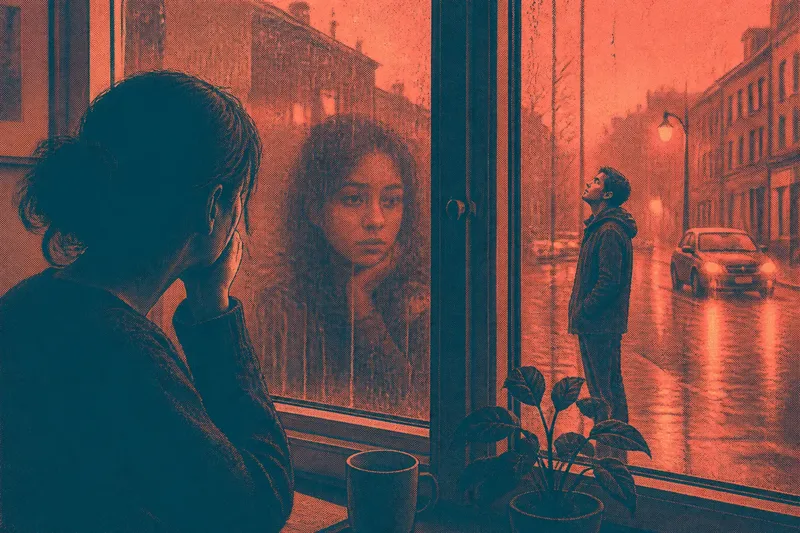
Glass can hold two images at once. A face may overlap a street, a lit room may appear on the pane after dusk, or a passing vehicle may cross both the reflection and the distant view. A change in shot, angle, or duration guides attention among these layers.
Notice whether a reflection appears before the film cuts to the person whose image it carries. The edit may let you register that person as part of the room before presenting them directly. If the reflection disappears at the cut, the transition can release the image from that doubled space.
A reflection need not be a clue with one fixed meaning. Ask what it makes visible: a face, an empty chair, a lamp, or an outside figure who would otherwise remain beyond the frame.
Track who can see through the glass
One character may get a clear view while another sees only a reflection or an opaque pane. The edit can establish that difference through shot placement, without dialogue. A cut to someone outside, followed by a return to someone watching indoors, creates a visual relation without showing either person cross the boundary.
Follow each character’s eyeline. After a look toward the window, the next shot might show what the character sees, or withhold the view and hold on their response. In one case, the viewer shares the character’s access; in the other, the viewer watches them want what remains unseen.
Say you are watching an invented scene: a tenant waits beside a rain-streaked window, and a friend stands on the sidewalk. The film first shows the tenant’s reflection, then cuts outside to the friend looking up, then returns to the tenant. No shot shows the door or either person crossing the threshold. The observable result is a connection made through exchanged looks, while the glass and unseen doorway preserve the separation.
What do rain and reflections change in a cut?
Does the film cut from rain on the glass to the street?
That cut can turn a surface detail into a route toward the outside world. Notice whether the street shot answers the indoor view or gives a different angle that keeps the characters’ perspectives apart.
Does a character appear in the reflection before a direct shot?
The reflection may let you recognize someone before the film gives them full visual focus. Watch whether the next cut confirms that presence or leaves it uncertain.
Does the film hold on the window after someone leaves?
A lingering view can preserve the room’s emptiness or direct attention to movement beyond the pane. Notice what becomes visible once the person is gone.
Does rain obscure the view or draw attention to it?
Streaks and droplets may soften the exterior, but they can also lead the eye toward one part of the frame. See whether the editing follows a figure through the blur or leaves the obscured view unresolved.
Compare the same window across scenes
When a film returns to one window, compare the framing rather than assigning the pane a single symbolic role. A character may fill the foreground in one scene and disappear from the composition in another. The same glass can feel like an opening when the camera looks outward and like a barrier when it holds on someone inside.
Look for visible changes: a curtain now drawn, a reflection brighter than the view beyond, or an empty patch of glass where someone previously stood. A return shot may echo an earlier composition, while a changed cut alters what the window connects. Keep the comparison tied to what is on screen.
If you watch on a small screen, wait until the scene ends before pausing to jot down its shot sequence from memory. Replay the passage to check which detail you missed. That second viewing gives you a focused question without interrupting the scene’s rhythm.
Record observations that lead to a viewing decision
For a compact record, check each point and let the result guide what you watch next:
- Frame: Check whether the window is central, at the edge, or behind a character. If it is central, track how the composition changes around it; if it is peripheral, watch for a later shot that gives it greater prominence.
- Image: Check whether the shot shows the exterior, a reflection, or both. If both appear, compare which layer remains clear after the cut; if only one appears, note whether the edit later introduces the other.
- Cut: Check which image comes immediately before and after the window shot. If the next image answers a character’s look, follow that visual link; if it does not, consider what the edit withholds.
- Access: Check which character can see clearly and which cannot. If their views differ, compare their reactions; if they share the same view, look for another visual distinction in their positions.
- Return: Check whether the window appears again with a changed curtain, reflection, or empty space. If a detail has changed, compare its new context with the earlier shot; if nothing visible has changed, focus on what the surrounding cuts now emphasize.
- Rain: Check whether droplets obscure a figure or direct attention toward it. If the figure remains discernible, follow its movement across cuts; if not, note whether the film resolves the view or leaves it hidden.
These notes keep an interpretation close to the image. “The cut moves from a reflected face to an empty street” describes an edit. “The character feels abandoned” is a reading that needs support from the rest of the scene.
Film editing through windows becomes legible when a pane’s function shifts without the location changing. Track the shot order and note who gets a view, who sees a reflection, and what remains hidden. The resulting account of distance rests on visible choices, not on the glass alone.